|
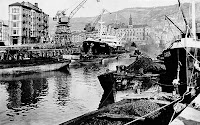
| A NINETEENTH CENTURY STEAMSHIP. The Blyth was a british ship built in Sunderland by J. Blumer & Co. and delivered to Blyth Shipping Co.in 1874. Like the Rivas she made lots of journeys between England and Spain along the end of the XIXth Century and the beggining of the XXth Century. In 1881 she sunk at Santoña bay, was refloated and taken to Bilbao, were she was mended and sold to Ardanaz & Cia. Her name was changed to Ardanaz. In 1898 she was bought by Eduardo Aznar Tutor and added to the Olaveaga Steam Company with the name Olaveaga. In october 1900 she got stranded at the entrance of Liverpool port. Two years later she had another accident. After that she was again mended and sold. Her now propietor was J.M. Bustamente, from Bilbao, who owned the La Blanca Navigation Company. Her name was now Gomechu. Her northern life ended in 1907 when she was sold to Mr. G Goñalons, who called her Antonia. Her new registration port was Mahon, in the Balearic Islands. The photograph shows the vessel at the docks of Bilbao |
Rivas was the name of a one thousand ton
steam ship that came and went between Bilbao and Newcastle during the
last years of the Nineteenth Century and the first years of the
Twentieth Century. On the 4th of december of 1904 this
vessel left Bilbao carrying 3263 tons of iron and 1219 litres of
wine. It had arrived the 24th of september with 2537 tons
of coal from Newcastle on board. It would be back on october bringing
more coal from Newcastle.
This we know because professor Manuel
Montero tells us in one of his works. But if you want to know in turn
how he has found out you will have to ask him, because he published
all this information in the papers, it was adressed to the general
public and he gave no bibliography there. Anyway though I can't tell
you what sources he has taken his data from professor Manuel Montero
is a historian and I bet they are pretty reliable.
From 1880 to 1920, he goes on, there was
a continous traffic of vessels joining both ports, wich sometimes
amounted to 25 or even 30 on a monthly basis.
 |
Ybarra nº 4 was another steamship wich
travelled intensively between the british industrial cities and
Bilbao. This watercolour is kept at the Untzi Naval Museum of San
Sebastian.
|
If we make a list of British ports
admiting mineral ore from Biscay in those days Newcastle would not
stand in the first place. For example, take year 1904. Cardiff and
Middlesborough were leaders followed by Rotterdam and Antwerp out of
the UK. What makes so special the relationship between Newcastle and
Bilbao is that ships would always transport an important cargo in
both directions.
So if Newcastle was not the main destiny
for Bilbao mineral ore albeit and important one the continous freight
carry in either direction made it the main supplier for coal. Most
frequently, more than 60% of all the coal that was imported into
Bilbao was coming from Newcastle.
Moreover Consett, near Newcastle, not
only was an industrial centre wich eagerly swallowed lots of iron ore
from the Biscay mines, but it was the headquartes of one of the four
societies wich were part of Orconera Iron Ore Co. Ltd., the most
important mining company in Biscay (one fifth of the total ore
extracted there belonged to them). These four societies were
Consett from Durhan, England
Dowlais from Wales
Friedrich Krupp from Essen, Germany
and Ibarra Hermanos from Biscay
 |
| A view of Bilbao with the swing bridge that was inaugurated in 1892 and destroyed in 1937 during the Spanish War |
Other ports at the Tyne riverside or
near it who also took mineral from Biscay belong today to the Greater
Newcastle upong Tyne connurbation. Professor Montero mentions Janow,
Tynemouth, Tyne Dock and Sunderland.
 |
Chroniclers in the late 1800s and early
1900s underlined that Newcastle upon Tyne had an inner port very
similar to the one Bilbao itself had on the banks of it's ria.
|