MARIA MAIZKURRENA'S BLOG, FEATURING BILBAO AS A REAL AND UNREAL CITY . STREETS AND PLACES, PEOPLE AND EVENTS, A BIT OF LITERATURE

Showing posts with label Streets. Show all posts

3.21.2013

Ercilla Street loves rainy days

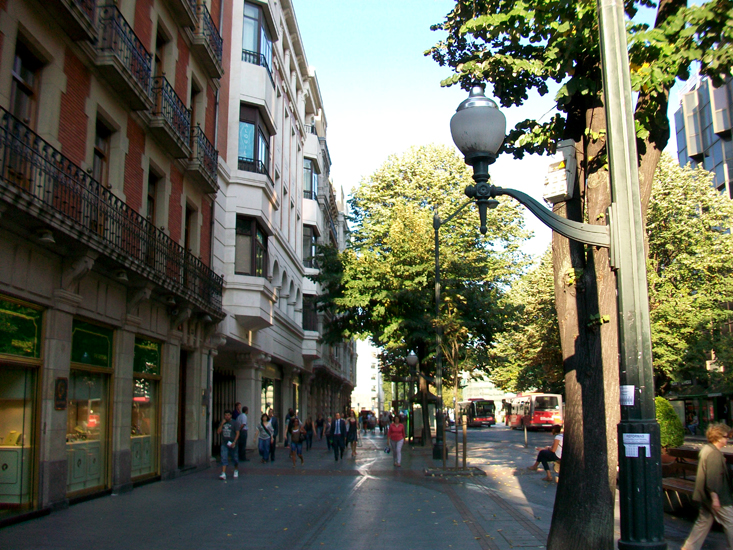
Take this walk along Ercilla Street in a rainy day from Mazarredo Boulevard to Moyua Circus... I mean, Alameda Mazarredo and Plaza Moyua. Bilbao isn't a city full of great monuments like many cities in Spain. No Roman aqueducts, no arab palaces here. That's why we had to buy that huge titanium castle,  Frank Gehry's contribution to the appeal of the city. The beauty of this place lies in those everyday surroundings where people's lifes take place. This is just another little bourgeois city of Europe grown into one of those  conurbations that melt diferent locations into one big map. Bilbao has climbed the mountains that encircle but in the mind of many of it's inhabitants it's still made of it's two old cores: the medieval one and the XIXth, Xxth Century one. Ercilla Street runs at the heart of the latter. There are many interesting buildings here, traditional ones, moderns ones, old and new. The street still has the atmosphere of something coming from the growth of the Ensanche, that is, the city expansion that jumped to the other side of the river from the Old Quartier. That was quite a long time ago...

Click on the photograph and get going


3.10.2012

AlhondigaBilbao, South and West


An Alhóndiga is usually a Corn Exchange, but this one was the city warehouse for wines and spirits. ( See alhondigabilbao.com )

Today, “AlhóndigaBilbao is a public area planned and designed for enjoying leisure time and cultural activities that promote personal development and foster human relationships”


The building stretches through a whole block dividing the Nineteenth Century Expansion Area from it's further growth beyond San Mamés Avenue. It was built in reinforced concrete and using brick, artificial stone and other materials chosen for being cheap and easy to maintain. The architect, Ricardo Bastida, was very young in 1905, when he designed the building taking good care to make the inside totally apt for its purpose and giving the outer walls an attractive and fancy look. The facades are compound of three horizontal elements each. There are towers on all squares and the four external walls have fronts that brake somehow the predominant horizontality.

The wine trade stopped in the 1970s, when a new warehouse was built in Recalde, and the Alhondiga remained empty for years. 

In 2010 it was reopened as a cultural Center. The inner space has been rearranged and designed by Philippe Starck


This is Iparragirre Street. If we could turn to the left, we would see Biscay Square (Plaza Bizkaia)


We look back for a moment, then we continue our walk.


This is the southern facade of the Alhondiga. The street is Fernández del Campo.


At this corner, Fernandez del Campo Street meets Alameda San Mamés (San Mamés Avenue)


We peep back through Iparragirre once more before turning left.


Alameda de San Mamés will lead us to Indautxu Plaza.


12.16.2011

Main Street of Bilbao: Gran Via

The part of the Gran Via we are walking through today is only one half, the first half, the first part that was built. If you want to read about its origins and Bilbao in the Ninetenth century, go to the post Gran Via de Don Diego Lopez de Haro
An entrance to the Bilbao subway train, designed by Norman Foster,
and also a view of Gran Via from Plaza Circular

A city like many other cities. As special as any other city. Nothing special. Somewhat characteristic. North of the South and South to the North. South to the nearby sea through which the bilboes (whatever they were) sailed to England some hundreds of years ago.

An old European city, and yet, tipically Ninetenth Century in its urban core.

Why does Bilbao have so little remainings from the Medieval Ages? Too many floods, too many fires and a growth too quick to be carefull in certains periods of the XXth Century.
The urban Expansion that was planned and executed during the last 1800s had its most important thoroughfare, its Main Street, where banks and trading companies hurried to take their places. The Main Street is called Gran Via, Gran Via de don Diego López de Haro. If we walk from the neibourhood of the Plaza Circular towards Plaza Moyua we will see the buildings, the trees, the windows, the paths, the shops you'll find in the following images. The photographs were taken a crazy autumn day that believed to be a spring morning.

If you're staying at some small hotel in the Old Quarter, lest's say the Petit Palace Arana or the Tryp Hotel, and you want to get to the Guggenheim Museum, the Main Street wil guide you. From the neighbourhood of the Moyua Plaza and from Moyua Plaza itself, were you can settle in the Carlton Hotel, both the Pelli Tower and Frank Gerhy's Guggenheim Museum are visible. If you have a room in one of those hotels of the Ensanche (the Nineteenth Century Expansion Area, where the industrial grounds have supported the rise of the new Bilbao), you are in the Gran Via or next to it. These hotels include NH Villa de Bilbao, Abba Parque, Hesperia Zubialde, Ercilla, Meliá (former Sheraton ), Miró, Dómine and others.


Today's walk starts at Plaza Circular and ends at Plaza Moyua. There are more than 50 images ahead, so it's better to double click one of them to start the slide show


To the post Gran Via de Don Diego Lopez de Haro