MARIA MAIZKURRENA'S BLOG, FEATURING BILBAO AS A REAL AND UNREAL CITY . STREETS AND PLACES, PEOPLE AND EVENTS, A BIT OF LITERATURE
Sections
An Incomplete Visual Guide to the City of Bilbao
(8)
Art and Festivals
(2)
Britons in Biscay
(2)
Excursions from Bilbao
(1)
Guggenheim Museum Bilbao
(2)
Hotels
(2)
Main Street or Gran Via
(3)
Museums and Cultural Centres
(2)
New Bilbao
(1)
Philippe Starck
(1)
Seasons
(3)
Songs and Poems
(3)
Streets
(4)
The Moon Road
(2)
Tips and Tales
(2)
Walking Bilbao
(2)
XIXth and XXth Century Bilbao
(6)
2.08.2015
1.27.2015
Bilbao Newcastle
Rivas was the name of a one thousand ton
steam ship that came and went between Bilbao and Newcastle during the
last years of the Nineteenth Century and the first years of the
Twentieth Century. On the 4th of december of 1904 this
vessel left Bilbao carrying 3263 tons of iron and 1219 litres of
wine. It had arrived the 24th of september with 2537 tons
of coal from Newcastle on board. It would be back on october bringing
more coal from Newcastle.
This we know because professor Manuel
Montero tells us in one of his works. But if you want to know in turn
how he has found out you will have to ask him, because he published
all this information in the papers, it was adressed to the general
public and he gave no bibliography there. Anyway though I can't tell
you what sources he has taken his data from professor Manuel Montero
is a historian and I bet they are pretty reliable.
From 1880 to 1920, he goes on, there was
a continous traffic of vessels joining both ports, wich sometimes
amounted to 25 or even 30 on a monthly basis.
![]() |
Ybarra nº 4 was another steamship wich
travelled intensively between the british industrial cities and
Bilbao. This watercolour is kept at the Untzi Naval Museum of San
Sebastian.
|
If we make a list of British ports
admiting mineral ore from Biscay in those days Newcastle would not
stand in the first place. For example, take year 1904. Cardiff and
Middlesborough were leaders followed by Rotterdam and Antwerp out of
the UK. What makes so special the relationship between Newcastle and
Bilbao is that ships would always transport an important cargo in
both directions.
So if Newcastle was not the main destiny
for Bilbao mineral ore albeit and important one the continous freight
carry in either direction made it the main supplier for coal. Most
frequently, more than 60% of all the coal that was imported into
Bilbao was coming from Newcastle.
Moreover Consett, near Newcastle, not
only was an industrial centre wich eagerly swallowed lots of iron ore
from the Biscay mines, but it was the headquartes of one of the four
societies wich were part of Orconera Iron Ore Co. Ltd., the most
important mining company in Biscay (one fifth of the total ore
extracted there belonged to them). These four societies were
Consett from Durhan, England
Dowlais from Wales
Friedrich Krupp from Essen, Germany
and Ibarra Hermanos from Biscay
![]() |
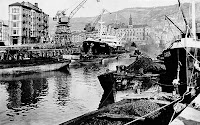
| A view of Bilbao with the swing bridge that was inaugurated in 1892 and destroyed in 1937 during the Spanish War |
Other ports at the Tyne riverside or
near it who also took mineral from Biscay belong today to the Greater
Newcastle upong Tyne connurbation. Professor Montero mentions Janow,
Tynemouth, Tyne Dock and Sunderland.
![]() |
Chroniclers in the late 1800s and early
1900s underlined that Newcastle upon Tyne had an inner port very
similar to the one Bilbao itself had on the banks of it's ria.
|
11.12.2014
Englishmen in Bilbao, Britons in Biscay
An Englishman came to Bilbao
to watch the estuary and the sea
but when he saw the local girls
he wouldn't go away.
(Un inglés vino a Bilbao
por ver la ría y el mar,
pero al ver las bilbainitas
ya no se quiso marchar)
People from all places think the girls in their town, city or whatever are the most beautiful in the world, and talking about local girls as of a sort of produce you can be proud of wasn't considered incorrect at the time the song appeared –and later.
We cannot be sure, anyway, if the man in the song was English, Welsh or Scot, because people here were not (and still are not) very skilled at distinguishing one from another, so they called them all “English”.
Looking on the web for something on this subject (Englishmen in Bilbao, Britons in Biscay) I came across an issue of History Today where Mike Thomas wrote about Bilbao's Britons: Mining in Biscay.
Why was I looking for it? Because Britons played an important part in the industrialisation of Biscay, which relied on the importance of the iron mines.
Professor Manuel Montero, from the university of the Basque Country (UPV-EHU) tells the story this way:
“Iron was mined in Biscay since the Middle Ages but it was halfway the Nineteenth Century when a new epoch opened. Iron from Biscay suddenly gained huge interest for the English steel industry after a new process was invented around 1950 in order to obtain steel. Bessemer converters were able to render a product of superior quality, better than usual until then, but it was necessary to employ a certain kind of mineral which was very scarce in England: non phosphoric iron ore. There were only two places in Europe where it was abundant: Sweden and Biscay. Iron ore from Biscay presented better conditions to be exploited for the English demand: it was very rich and easy to extract for it could be found near the surface. The mines war not far away from the coast, so it could be transported without great cost. And even mining was cheap because there was plenty of labour at the industry's disposal. Unlike the sweden ore, iron ore from Biscay could be extracted and shipped all the year through.”
The article on History Today has a subhead:
“Mike Thomas looks back to a period of economic buoyancy in the Basque region, when a special relationship flourished between the people of Biscay and Britain”
Then the author introduces William Gill, who far back in the mid-1880s was the British managing director of the Orconera Iron Ore Company, a conglomorate of British, Spanish and German enterprises in the Biscay region.
And so, through the Gill family we find ourselves right in the middle of that time when industrialisation was taking off in Bilbao and its surroundings and there was a British community of several hundreds settled in Abando (which disappeared as an independent town in 1890 being today the central district of Bilbao), Bilbao itself, Portugalete and Baracaldo.
Touch the photograph to go to Mike Thomas' article, but I advise you that to read it from beginning to end you must subscribe to History Today.
10.17.2014
Town of Plentzia. Along the riverside
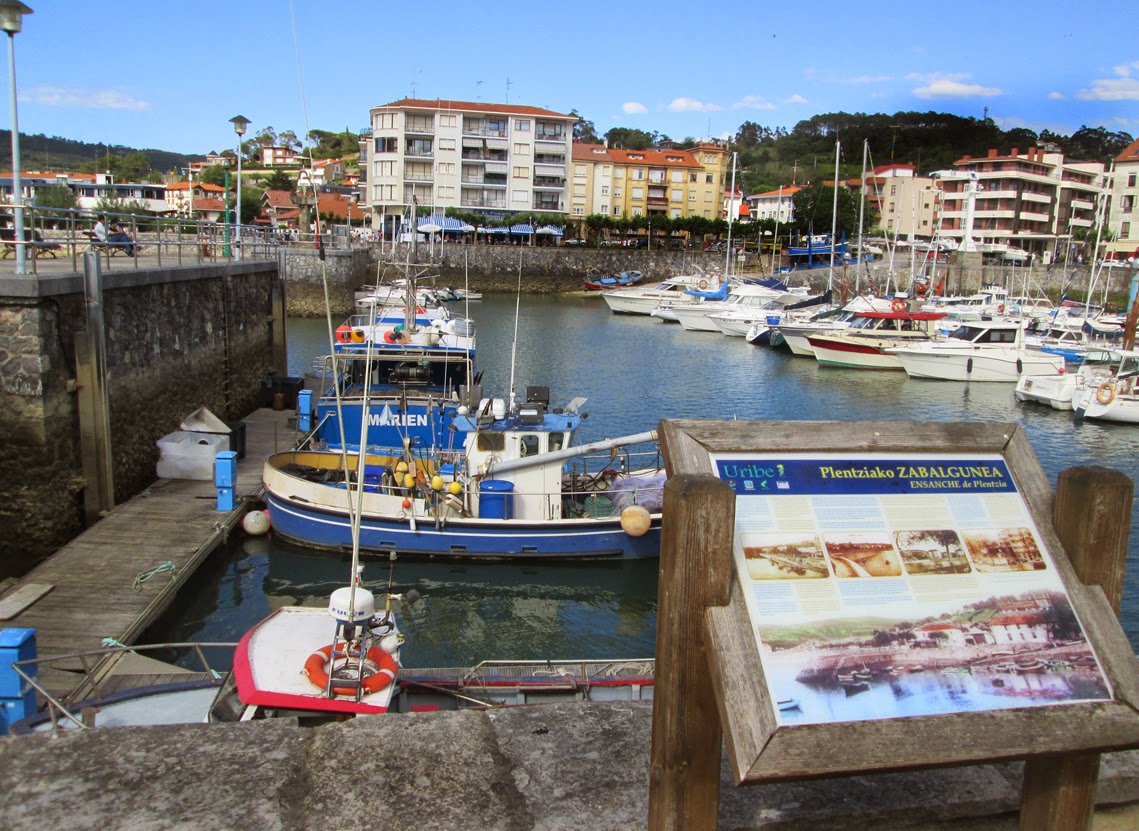
The town of Plencia or Plentzia (the lattest is the official basque name) is 25 kms north east from Bilbao. It grew in a bend of the river, which forms a beautiful estuary in the proximity of the sea. Plentzia shares a bay with the nearby municipalities of Gorliz and Barrika. There are three beaches in the bay, namely Plencia, Gorliz and Astondo. In summer they get very crowded, so if you don't want to sunbath and you think walking by the sea is much better, autumn, spring or even late winter is the perfect time for it. Plentzia is one of the places we people from Bilbao visit very often, because it's so near and we can even go by underground, though of course the train comes up to the surface before leaving Bilbao which makes the trip far more interesting and definitely nicer (imagine going all the way through a 25 km tunnel).
These photographs were taken on July. It was'nt summer yet, but the light is very different from the one that fills the scenes in a set of photographs I took last week. This is autumn light, and you can see it HERE
In both cases, the walk along the riverside started more or less at the beggining of Zugaitz Bidea, leaving the bridge behind. It continued along Ibiltokia Ibilbidea, but in this series of photographs it stops at Arraun kalea after we reach the port.
In the photographs you can see in my other blog the walk still continues through Areatza Iribidea and Portu Kalea. There are also houses and views which do not appear in the images that follow. In the same way, though the places are the same, different things and perspectives can be found here.
Go Up
The other set of photographs
Subscribe to:
Posts (Atom)